
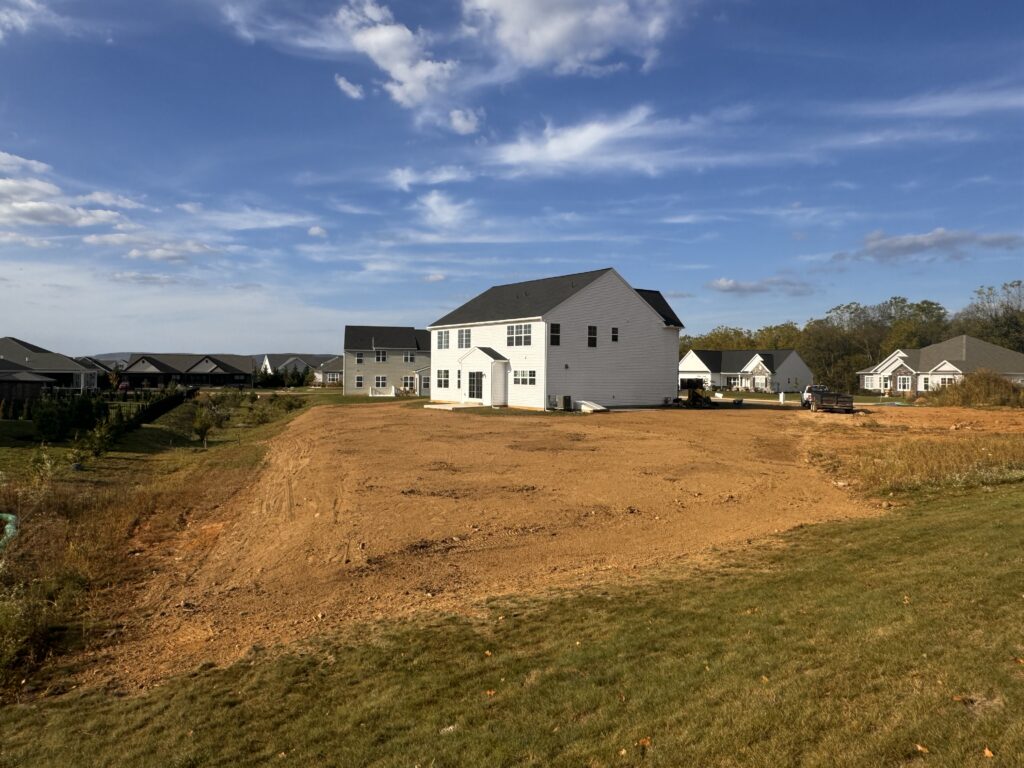
You bought a brand-new home in a beautiful development. The house is perfect, the paint is fresh, and the driveway is pristine. But the first time a heavy Central PA storm rolls through, you notice something frustrating: your backyard turns into a swamp.
Water pooling in yard areas is one of the most common complaints we hear from homeowners in Mechanicsburg, Camp Hill, and the surrounding areas—especially in new construction.
If you are tired of wiping muddy paws and looking at a lawn that never seems to dry out, here is why it’s happening and exactly how to fix it.
The Root Cause: It’s Not Just Rain, It’s Soil
Many homeowners assume that water pooling is just a fact of life during a wet spring. But if your neighbors’ yards are dry and yours is a lake, the issue isn’t the weather, it’s the ground conditions left behind by the builder.
There are two main culprits for standing water in new developments:
1. Compacted Clay Soil
Central Pennsylvania is famous for its heavy clay soil. In a natural state, this soil drains slowly. But during construction, heavy machinery (bulldozers, excavators, and cement trucks) drives over the land repeatedly. This compresses the clay into a hard, impermeable layer that acts almost like concrete. When rain falls, it can’t soak in, so it sits on top.
2. Poor “Rough Grading”
Builders are often in a rush to move to the next lot. They typically perform a “rough grade” to slope the ground away from the foundation, but they often leave low spots, dips, or “negative grades” in the middle of the yard. These act as bowls that collect runoff from your roof and downspouts.
Why You Shouldn’t Ignore Water Pooling
A muddy backyard is more than just an eyesore; it’s a liability for your property. Ignoring standing water can lead to:
- Foundation Damage: If water pools too close to your home, it can seep into your basement or crawlspace, causing cracks and mold.
- Dead Grass & Plants: Turf cannot survive underwater. The roots rot, leaving you with patchy, brown, or bare spots that turn into mud pits.
- Mosquito Breeding Grounds: It takes very little stagnant water for mosquitoes to lay eggs, turning your backyard into a no-go zone in the summer.
The Solution: Professional Yard Grading & Drainage
Throwing more grass seed on a muddy puddle won’t fix the problem. To stop water pooling in your yard for good, you need to address the shape and structure of the land.
At Ingold Landscaping, we specialize in correcting builder-grade mistakes through professional yard grading services and drainage solutions.
Corrective Grading
We bring in equipment to reshape the land, eliminating low spots and ensuring a proper slope that directs water away from your home and into appropriate drainage swales or storm sewers.
Soil Conditioning & Sod Installation
Often, the best fix for compacted clay soil is to loosen it up and add a fresh layer of nutrient-rich topsoil. Once the grade is fixed, we can install fresh sod. Sod has an established root system that helps absorb water faster than bare dirt or seed, giving you an instant, usable lawn.
French Drains & Downspout Extensions
Sometimes, the volume of water is simply too high for the soil to handle. We can install underground drainage systems to catch water from your downspouts or low spots and pipe it safely away from your usable outdoor space.
Get Your Yard Back
You didn’t buy a new house to have an unusable backyard. If you are dealing with water pooling in your yard, don’t wait for the next storm to make it worse.
Ingold Landscaping has the heavy equipment and the local expertise to fix drainage issues in Mechanicsburg and beyond. Let us turn that mud pit into the lush, dry lawn you paid for.